Websites, ecommerce paths and business systems built for founder-led teams that need clarity, speed and ownership.
For SMEs that need a clearer website, cleaner operations or both. You work directly with Muntazir from diagnosis to launch, with private previews, practical timelines and documented handover.
Start with one business problem. Ship the useful slice first.
01Diagnose
02Private preview
03Go live
04Improve
Best for founder-led teams that want senior hands-on delivery, not a heavy agency chain: websites, ecommerce, analytics, SEO foundations, workflow automation and operating dashboards.
Projects start with a fixed-price Workflow Map, then move into a scoped build only if there is a fit.
Private preview → live system → improvement.
Scroll
● Pre-payment assurance
What you can verify before you commit.
Before payment, the proposal separates the evidence available for your brief from the work being proposed. It states the included journey or workflow, acceptance checks, timeline dependencies, account ownership, handover items, support boundary, contracting name, invoice issuer and payment schedule.
01 · Delivered evidenceOne permissioned public delivery example.
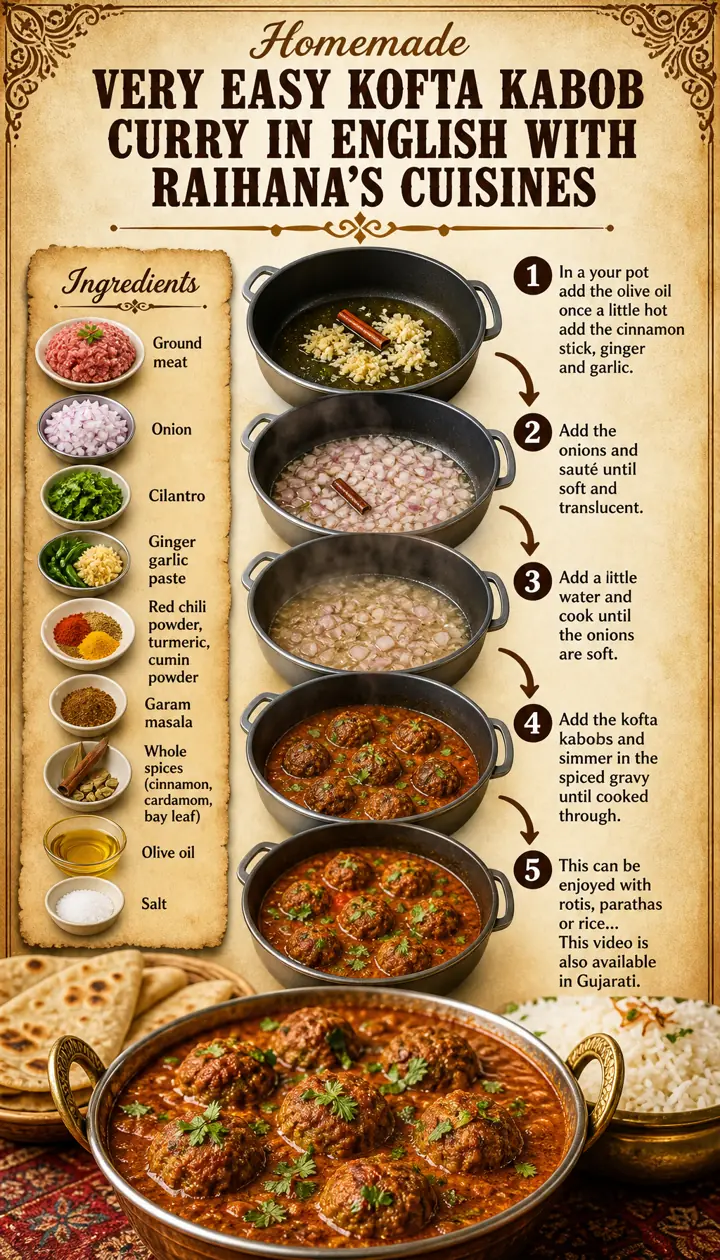
Raihana’s Cuisines shows one delivered implementation: structured recipe records, public discovery, ingredient search, pantry matching, shopping-list output and a managed review workflow.
Project counts dated 28 July 2026 come from seller-maintained delivery records. They show volume handled — not revenue, traffic, conversion, rankings, time saved or ROI.
02 · Scope and acceptanceOne agreed system — not the whole capability list.
A fixed-price First System covers one agreed customer journey or operating workflow. The proposal lists included pages, roles, integrations, migration work, content responsibilities, analytics events, SEO tasks, launch controls and acceptance checks.
Anything not listed is outside the fixed scope unless added in writing.
03 · Timeline and supportThe clock and support boundary are agreed before work starts.
Delivery begins after acceptance, the agreed starting payment, required access and initial content are in place. First System support covers accepted-scope defects, launch configuration issues and handover questions for 30 days.
New features, provider outages, emergency cover and guaranteed resolution times require separate agreement.
04 · Ownership and continuityThe work is designed to be transferable.
The proposal identifies who owns each domain, repository, hosting account, analytics property, payment-provider account and subscription.
Handover records include source files, deployment instructions, dependency inventory, non-secret environment-variable names, known limitations and outstanding items.
05 · Commercial identityThe contracting party is disclosed before payment.
Muntazir.tech is the service brand for founder-led delivery by Muntazir Pyarali. Before payment, the proposal states the legal contracting name, invoice issuer, payment schedule and applicable commercial terms.
These schematic surfaces explain the kind of operating layers a practical build can touch: public experience, private operations, automated hand-offs, measurement and hosting. They are diagrams, not client screenshots.
PublicCustomer-facing experience
The website, booking flow, content tool or product surface people actually use.
PrivateOperations console
The controlled workspace for review, edits, approvals and publishing.
AutomatedWorkflow trigger
The repeated hand-off becomes a route, rule or queue instead of daily chasing.
MeasuredKPI view
The work leaves a signal: submitted, reviewed, blocked, improved.
LiveHosting & improvement
Private while testing, live when ready, then improved from real usage.
01 — Consult
Pick the pressure point
Before we build, we find whatis slowing the work down.
Choose the closest pressure point. The section opens into a practical diagnosis: what it is costing, what I would build first, and the first useful milestone.
Pressure-point assessment — automation workflow
What this can disrupt
Delayed replies, repeated errors and one person becoming the bottleneck because the same data is copied, checked and chased across tools.
What I would build first
A source-of-truth workflow that routes the hand-off automatically and shows what is waiting, complete or blocked.
First useful milestone
A mapped hand-off, agreed source of truth and one working automation in a private preview.
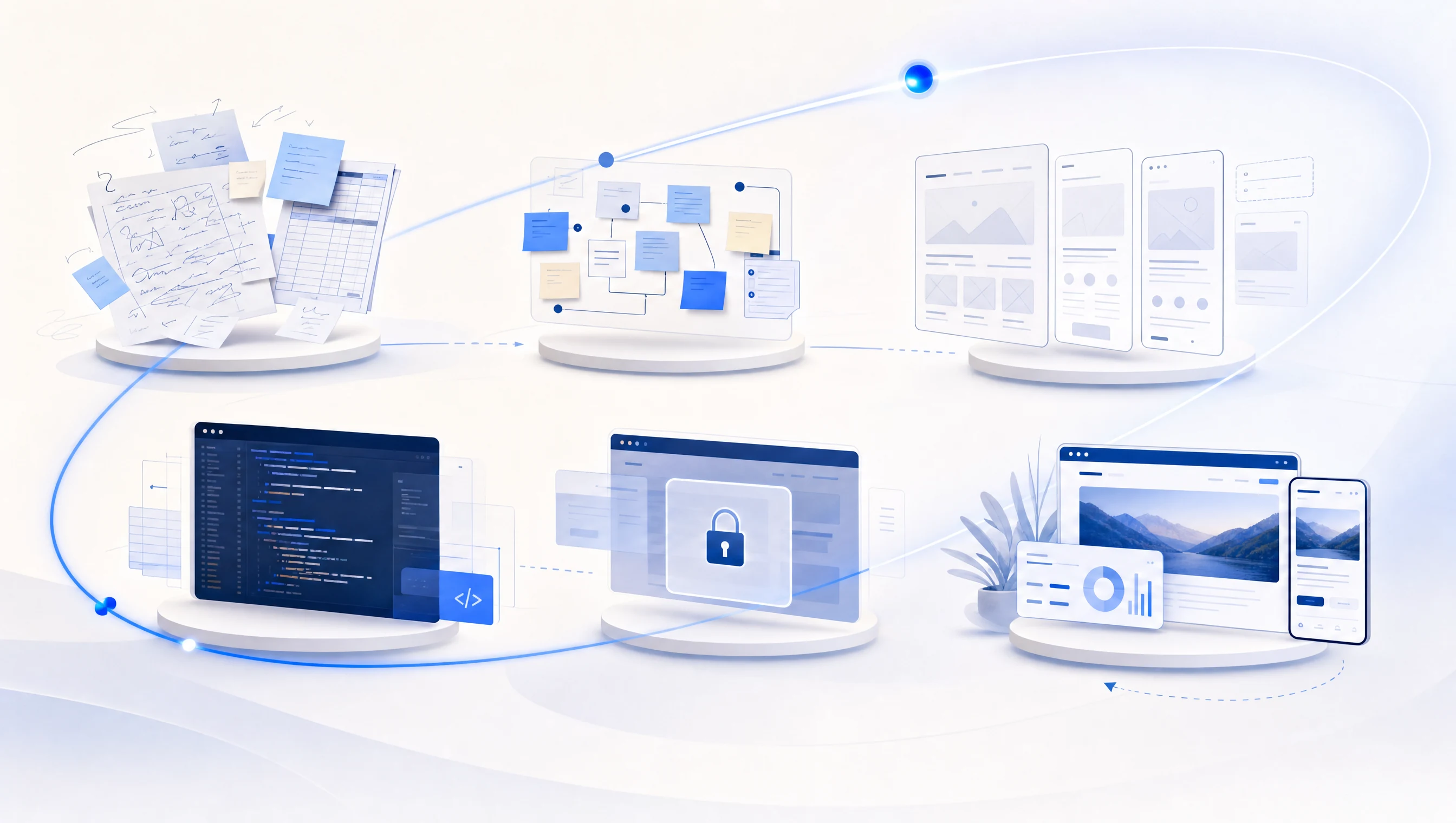
Websites, dashboards and internal tools are shaped into a private preview first. The work is reviewed safely, hosted properly, moved live when ready, and improved from real usage — with the dot tracking the whole operating path.
Step 01 · Rough briefA rough brief, screenshots, spreadsheets and notes are enough to begin.
Step 02 · ShapeConvert scattered inputs into one workflow, decision path and build scope.
Step 03 · BuildBuild the smallest useful system: interface, data, logic and hosting path.
Step 04 · Private previewReview safely behind a private link before any public launch.
Step 05 · Hosted liveMove the app or site live properly, then improve from real use.
PlanShape the idea
Make the rough version legible enough to build.
PreviewBuild privately
One useful slice appears behind a safe preview link.
LaunchHost it live
Move the working version onto its proper domain.
SupportImprove with usage
Real activity shows the next layer to add.
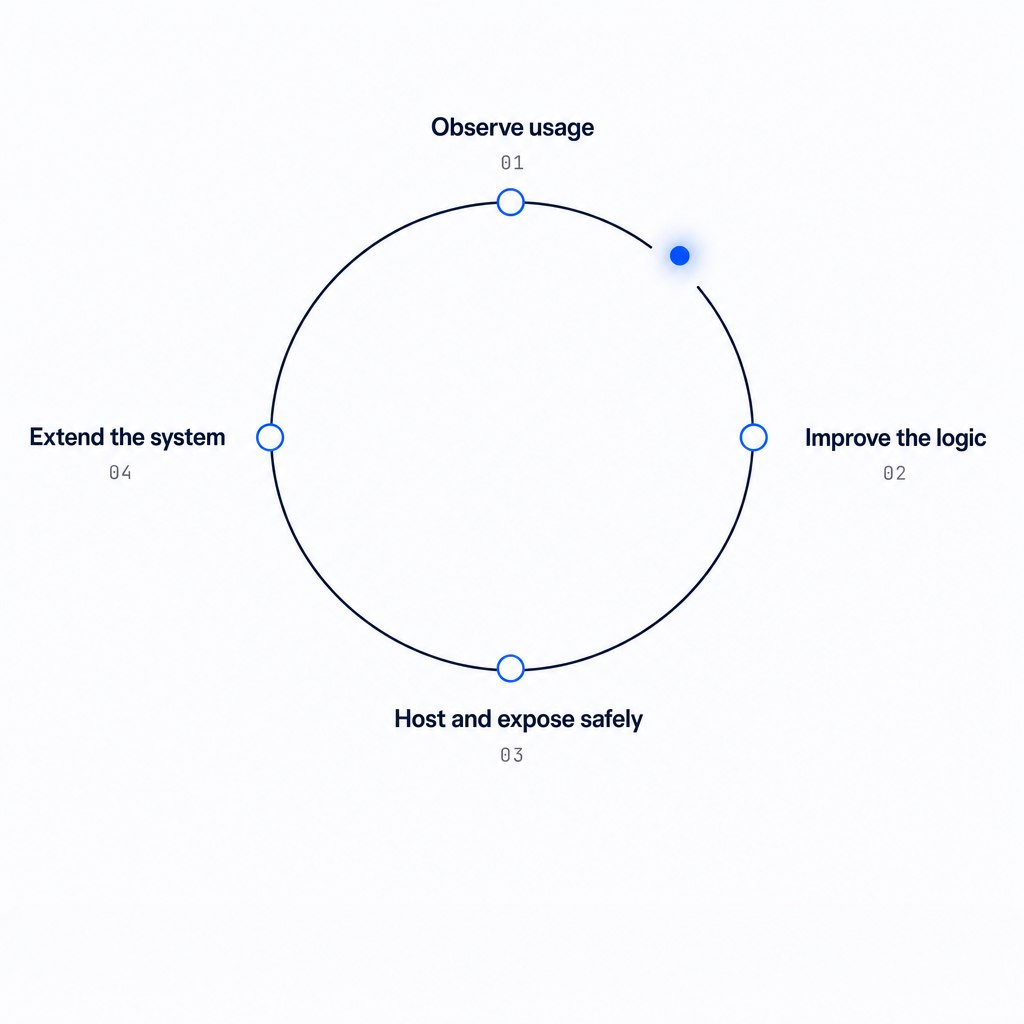
Build once, learn continuously. Once live, the work shows where to improve next — observe usage, refine the logic, extend the system. The recommended approach is to begin with one workflow and extend only after it is useful.
03 — Live system capabilities
Commerce · SEO · analytics · security
Going live is where theoperating system begins.
Available capabilities — not included by default. A build may use some of the capabilities below, but they are not a bundled promise. Your proposal identifies the agreed storefront, cart, payment-provider integration, SEO foundations, structured data, consent-aware analytics, CRM or order handoff, integrations and practical security controls included in your scope.
Technical SEO, structured data where appropriate, metadata, crawlability and content architecture to support search understanding.
02 · BrowseStorefront & cart
Products, variants, inventory rules and cart behaviour shaped around how customers browse, compare and decide.
03 · CheckoutPayments & order flow
Payment-provider integration, shipping and tax logic, confirmations and recoverable failure states from cart to completed order.
04 · MeasureAnalytics & events
Consent-aware analytics events, Search Console and relevant product or campaign integrations selected per proposal around meaningful actions, not vanity traffic alone.
05 · OperateAdmin hand-off
Orders, enquiries and customer actions routed into the right admin view, fulfilment workflow, CRM or accountable next step.
AccessIdentity & permissions
Protected administration, role-based permissions, session controls appropriate to the agreed authentication design and controlled access to private business functions.
ProtectApplication & data controls
Input validation, secret handling, dependency management, rate controls and sensible data boundaries for the actual risk profile.
RecoverMonitoring, backup & recovery planning
Monitoring, error visibility, backup planning and recovery paths so problems can be detected, contained and resolved.
Security and payments are scoped honestly. Payment details stay with the payment provider wherever possible. SEO improves foundations and discoverability; it does not promise rankings. Analytics should be consent-aware. Specific providers, controls and compliance requirements depend on the product, jurisdiction and risk profile.
04 — Pricing and project shape
Clear starting points
Know the likely investmentbefore you book a conversation.
Projects are scoped individually, but founder-led teams should know the level of commitment before a call. These are practical entry points, not vague agency retainers.
Entry door · 1 week
Workflow Map
AED 2,000credited against the build if you proceed
For teams that know something is inefficient but need the first build defined clearly.
Important: prices are starting points for founder-led SME work. Ecommerce, payment-provider integrations, data migration, custom dashboards, compliance requirements, third-party fees, copywriting, paid ads and complex integrations are scoped before build.
Included in quoted build
One agreed customer journey or operating workflow
Private preview before launch
Agreed data and integration work
Launch preparation and documented handover
30-day defect and handover support for First System builds
Usually quoted separately
Substantial migration, data entry or content production
Additional workflows, user roles or custom integrations
Compliance-specific work, paid ads and campaign management
Third-party subscriptions, provider fees and transaction charges
Client responsibilities
One accountable decision-maker
Timely content, access and feedback
Approval of scope, milestones and review windows
Ownership and payment of agreed third-party accounts
Timing assumptions: timelines begin after proposal acceptance, the agreed starting payment, required access and initial content are in place. Client approvals, third-party reviews, migration discoveries or scope changes can move the launch date. The proposal confirms milestones and dependencies before work starts.
● Buyer trust ledger
Before you commit: what is evidenced, what is scoped, and what you own.
This ledger separates delivered evidence from demonstrations and records the commercial boundaries that matter before work begins.
Delivered public evidence
Raihana’s Cuisines public project example.
The visible proof covers the public recipe experience and delivery-scale records dated 28 July 2026.
The figures measure records, assets and review items handled. They do not claim revenue, traffic, conversion, rankings, time saved or ROI.
Synthetic demonstration
Private operations pattern without private data.
The KPI workspace demonstrates submission, review and exception-routing patterns using synthetic labels.
It demonstrates a workflow model; it is not evidence of client adoption or a measured client outcome.
Defined in proposal
One First System, not unlimited scope.
A First System covers one agreed customer journey or operating workflow. The proposal lists included pages, roles, integrations, migration, content responsibilities, analytics events, SEO tasks, launch controls and acceptance checks.
Anything not listed is outside the fixed scope unless added in writing.
What changes price
Quote drivers are made explicit.
The quote changes mainly with the number of workflows and user roles, data condition, migration volume, integrations, payment complexity, content readiness and specialist requirements.
Third-party subscriptions, provider fees, transaction charges and specialist reviews remain separate unless included in the proposal.
Handover record
Continuity is documented around accounts and deployment.
The proposal identifies the owner of each domain, repository, hosting account, analytics property, payment-provider account and third-party subscription.
The handover package includes source files, deployment instructions, dependency inventory, environment-variable names without secret values, known limitations and outstanding items.
Clock and response boundary
Timelines and support have start conditions.
Timelines begin after acceptance, starting payment, required access and initial content are in place. Included support covers accepted-scope defects, launch configuration issues and handover questions.
Support is acknowledged and triaged within one business day; 24/7 emergency cover, uptime commitments and guaranteed resolution times require separate written agreement.
Commercial identity
Muntazir.tech is the service brand.
Muntazir.tech is used for founder-led delivery by Muntazir Pyarali. The legal contracting name, invoice issuer, payment schedule and applicable commercial terms are shown in the proposal before payment.
No company registration, VAT, insurance or certification claims are made on this public page.
Payment-provider boundary
Checkout work depends on provider responsibilities.
Payment-provider integration can cover checkout flow, confirmations and recoverable failure states.
Provider onboarding, KYC, merchant approval, refunds, chargebacks, tax setup, transaction fees and account ownership are scoped before build.
Plain-English rule: every proposal should state what is being built, what evidence supports the approach, what is excluded, who owns each account and when the support clock starts.
01 · Fit call20 minutes to check fit.
We confirm the problem, urgency, budget range and whether the first step should be a Workflow Map or direct proposal.
02 · Scope agreedResponsibilities before build.
The proposal confirms scope, payment schedule, dependencies, provider responsibilities and review milestones before work starts.
03 · Private previewYou review the useful slice.
The first version is built privately so structure, content, data and hand-offs can be checked before public launch.
04 · Acceptance & launchMove live when ready.
The site or system goes live after core pages, forms, analytics, access, acceptance items and operational hand-offs are working.
ContinuityWhat if Muntazir is unavailable?
Work is documented as it goes: project repository, source files, deployment notes, dependency inventory, account ownership, non-secret environment-variable inventory, known limitations and handover items agreed in the proposal, so another capable developer can assess and continue the work.
Scope controlDoes one person really cover all this?
The offer is deliberately focused: one clear website, ecommerce path, workflow, reporting workspace or operating slice at a time. If specialist work is required, it is identified before commitment and separately approved with responsibility, access and cost made clear.
Support termsWhat happens after launch?
First System projects include 30 days support for defects against accepted scope, launch-related configuration issues and handover questions. Support requests are acknowledged and triaged within one business day; this is not a guaranteed resolution time. New features, content population, provider outages, emergency cover and scope changes are not automatically included.
OwnershipWho owns the stack?
The client owns the project outputs, code repository, content and operational accounts unless a third-party service, open-source licence, pre-existing material or unpaid balance has its own terms. Credentials and deployment access are documented during handover.
AudienceFounder-led SMEs and owner-managed teams.
EngagementFixed map, scoped build, or monthly support.
ResponseOngoing partner tier: acknowledged and triaged within 1 business day.
Legal docsTerms and Privacy are linked in the footer for review.
Included 30-day support
Defects against the accepted scope
Launch-related configuration issues
Handover questions and minor launch clarifications
Not automatically included
New features, new integrations or scope changes
Content population and third-party provider outages
24/7 emergency cover, uptime SLA or guaranteed resolution time unless separately agreed
Who you work with
Founder-led delivery by Muntazir Pyarali under the Muntazir.tech service brand.
Based in Dubai, UAE; working with founder-led SMEs and owner-managed teams. Contact: muntazir@muntazir.tech. The contracting party, invoicing details, payment schedule and provider responsibilities are stated in each proposal.
05 — Build · public case study
Raihana’s Cuisines proof
Raihana's Cuisines: a review-heavyarchive became a usable system.
Private preview first · hosted live when it works
Raihana’s Cuisines shows one delivered implementation of the method in a public, privacy-safe way: a large archive moved through structured records, review tracking, public discovery, ingredient search, pantry matching and shopping-list output.
Role
Product direction, public recipe experience, ingredient taxonomy, pantry-finder logic, shopping-list output design and admin support.
Stack
Next.js, TypeScript, SQLite, Tailwind CSS, PDFKit, Sharp and a custom recipe database. The stack, dependencies, account ownership and handover requirements are documented for the project.
ProblemContent existed, workflow did not.
The archive needed structure, review status and public discovery.
Work deliveredRecords, finder, assets, review.
Public features and private operations were treated as one product.
Operational output1,355 review items logged.
Review and approval work was tracked through the workflow instead of left in scattered notes.
Public capabilityA usable recipe tool.
Visitors can search, match ingredients and build shopping lists.
649recipe records prepared for structured discovery
332public recipes live with ingredient search
648recipe-card assets managed
1,355review items recorded in the workflow
Delivered Kofta Kabob Curry — public recipe surface
Smart archiveFamily recipes become searchable records.
649 records structured with measurements, pantry groups and diet-note fields prepared.
Pantry finderSearch by what's already in the fridge.
Recipes ranked by how many ingredients a visitor already has at home.
Shopping outputA grouped list, ready to download.
Grocery output grouped the way a supermarket is laid out — recipe page and cart align.
RepresentativePrivate operations stay private.
Admin/workflow surfaces are described or recreated safely — no private data is shown.
Try it — the pantry finderlive logic from the delivered feature
Tap what's already in your fridge:
Kofta Kabob Curry0 of 4 ingredients matched
Best match
Delivered proof Figures show delivery scale from the project database and asset records, recorded from project delivery records on 28 July 2026. Public case details are shown without exposing private staging links. Representative private workflow details use synthetic labels only.
06 — Private operations pattern
Synthetic demonstration
A useful build gets more valuableas the business grows.
● Synthetic demonstration
A synthetic model for making submissions, reviews and open items visible.
A privacy-safe synthetic demonstration showing how monthly submissions, reviews, exceptions and leadership visibility can fit into one operating flow. It does not display client data, imply a named client system or claim a measured client outcome.
Representative technology pattern: Next.js, React, TypeScript, SQLite, Drizzle ORM and Tailwind CSS. Labels are synthetic; no company names, logos or live operational data are shown.
SubmitEvidence captured
ReviewManager checks
ResolveOpen items routed
Synthetic workflow states — no client data, company names, staff details or measured outcomes are displayed.
● Improvement loop
The launch is not the finish line. It is when the useful data begins.
01 · Observe usageSee delays, errors, adoption and new needs.
02 · Improve the logicRefine rules, dashboards, prompts and workflow.
03 · Host and expose safelyPrivate while testing, live when ready.
04 · Extend the systemAdd modules, integrations and user journeys.
07 — Book a fit call
No obligation
Book a 20-minute fit call.Then map the first system.
Send the messy version or book a short fit call. If there is a fit, the usual first paid step is the AED 2,000 Workflow Map, credited against the build if you proceed.
Consult. Automate. Build. Evolve.
Recommended starting point
Workflow automation assessment
Map the repeated process, define the source of truth, and build the first automation that removes a manual hand-off.
First paid step: AED 2,000 Workflow Map. I map the process, define the first build and give you a scoped quote. If it is not a fit, I will say so before you spend more.